
Last updated: October 8, 2026

 November 1, 2024
In This Article
- How This Analysis Works
- Understanding the Chart
- The Longevity Tiers
- S-Tier: The Walking Revolution (7+ years)
- A-Tier: The Core Four (2-4 years each)
- B-Tier: Daily Habits That Matter (1-2 years each)
- C-Tier: Strategic Additions and Subtractions (6-11 months)
- D-Tier: Still Worthwhile (2-5 months)
- Practical Implementation
- Using This Framework
- Your Personal Opportunity
When I released v2.0 of the True Age calculator, I adjusted the baseline to account for the average American level of each intervention. The results challenged many common assumptions about health. While everyone talks about superfoods and supplements, simple activities like walking has many benefits
How This Analysis Works
I’ve converted complex mortality statistics into a simple metric: years added to life beyond what average Americans already achieve. For example, the average American walks 4,000 steps daily, gaining 3.3 years of life compared to being sedentary. The numbers I share are additional years you could achieve on top of this baseline.
These figures are based on a 40-year-old man. Women typically gain 10% less benefit, while someone 10 years younger gains about 10% more.
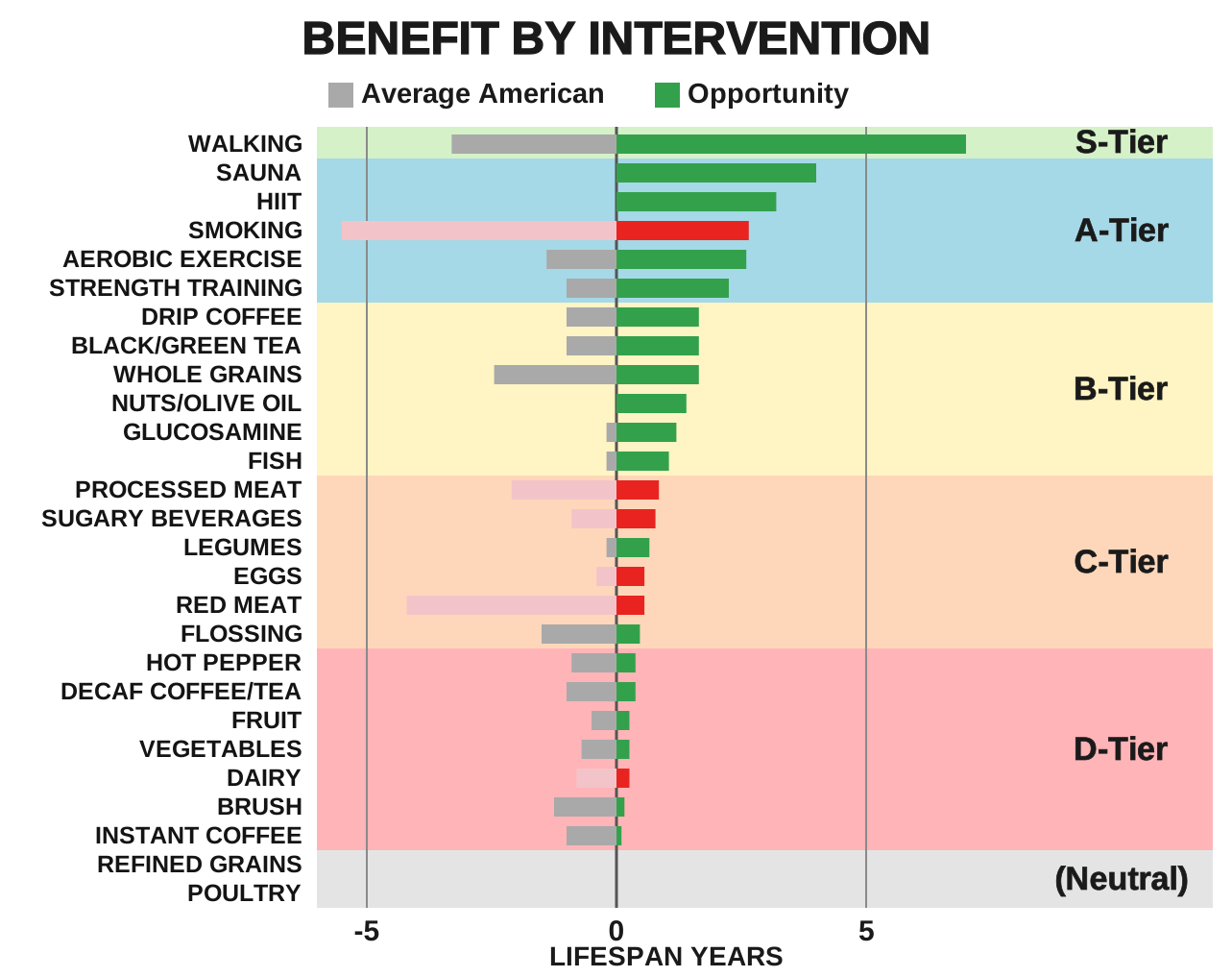
Understanding the Chart
Looking at the data visualization, each intervention can combine two components:
- Grey bars extending left show the years of life the average American already gains from current habits. For example, Americans already gain some benefit from their fruit and vegetable consumption—this is built into the baseline.
- The green bars extending right show the additional years you could gain by optimizing the intervention. The sauna bar is entirely green because most Americans don’t use saunas, representing a pure opportunity for improvement.
- Red bars extending right show years of life lost from harmful habits that should be eliminated. Smoking shows both grey and red—the grey represents the years lost because some Americans smoke, while the red represents the additional years that could be added by quitting to current smokers.
This format helps explain why some heavily promoted interventions like eating more vegetables show relatively modest green bars—Americans are already capturing much of the benefit (shown in grey). Meanwhile, interventions like walking and sauna show large green bars because they represent primarily untapped potential.
The Longevity Tiers
The chart reveals clear groupings in the potential benefits of different interventions. I’ve organized these into tiers based on the additional years they can add to life:
- S-Tier: 7+ years added
- A-Tier: 2-4 years each
- B-Tier: 1-2 years each
- C-Tier: 6-11 months each
- D-Tier: 2-5 months each
S-Tier: The Walking Revolution (7+ years)
Walking stands alone at the top, offering an additional seven years beyond the 3.3 years the average American gains from their 4,000 steps daily. At 12,000 steps daily, that’s 10.3 years of added life expectancy. The benefit comes only from walking; running the same distance counts as aerobic exercise.
Starting small works: each additional 1,000 daily steps beyond your current level adds about 0.8 years to life. Park farther away, take walking meetings, or do your errands on foot. Your phone or watch can track steps automatically, making this the easiest intervention to measure.

A-Tier: The Core Four (2-4 years each)
The Exercise Trinity leads this tier:
- Aerobic exercise: 2.6 years
- HIIT (High-Intensity Interval Training): 3.2 years
- Strength training: 2.3 years
Each requires just 1-2 sessions weekly for full benefits. You can combine them efficiently: a HIIT session with jogging between sprints covers aerobic and high-intensity training in one workout.
The fourth A-tier intervention surprises most people: regular sauna use adds 4.0 years when done 4-7 times weekly. That figure now comes with a condition. Sauna is A-tier if you are aerobically unfit, but if you are already aerobically fit there is little detectable additional benefit to all-cause mortality, because the cardiovascular gains overlap with what your training already delivers (see What I Changed in the Calculator). For the unfit it remains one of the strongest single moves available, and you have options:
- Traditional sauna at a gym
- Hot bath (provides partial benefits)
- Infrared sauna blankets
Smoking cessation also appears here, with the actual benefit being more significant than shown since our baseline includes current smokers. If you smoke, this becomes your top priority.

B-Tier: Daily Habits That Matter (1-2 years each)
These interventions punch above their weight, requiring minimal time for significant gains:
- Coffee or tea (1.7 years): 2.5 cups of drip coffee or 5 cups of tea daily
- Nuts (1.4 years): Just 20g (about 20 almonds) daily. Timing matters—small daily portions work better than larger weekly ones
- Whole grains (1.7 years possible beyond average intake): A daily bowl of oatmeal or two slices of whole-grain bread
- Glucosamine (retracted): I previously credited about 1.2 years, but now consider the benefit healthy-user bias (see The Ozempic Challenge)
- Fish (1.1 years): 200g daily

C-Tier: Strategic Additions and Subtractions (6-11 months)
What to eliminate:
- Sugary beverages
- Processed meats
- Red meat
- Daily eggs (one every other day is fine)
What to add:
- Legumes (8 months): One serving daily
- Daily flossing (6 months)
D-Tier: Still Worthwhile (2-5 months)
These often-hyped interventions offer modest returns:
- Fruits and vegetables (4 months each)
- Weekly spicy peppers (3 months)
- Decaf coffee (3 months)
- Brushing teeth nightly (2 months)
Dairy becomes concerning only above 4 cups daily. Between zero and two cups shows a negligible effect on longevity.
Practical Implementation
Looking at the chart, a clear strategy emerges. The top six interventions (walking, sauna for the aerobically unfit, HIIT, smoking cessation, aerobic exercise, and strength training) account for about 60% of the potential benefit. Start there.
Some combinations work naturally together:
- Morning walk to get coffee (S-tier + B-tier)
- HIIT with jogging recovery periods (two A-tier interventions)
- Strength training followed by sauna at the gym (two A-tier interventions, though the sauna half counts only if you are not already aerobically fit)
- Oatmeal with nuts for breakfast (two B-tier interventions)

Using This Framework
When evaluating any health intervention, consider its mortality reduction:
- S-tier: 48%+ reduction
- A-tier: 24%+ reduction
- B-tier: 12%+ reduction
- C-tier: 6%+ reduction
- D-tier: <6% reduction
This reveals surprising insights. Reducing sleep from 9 to 7 hours reduces mortality by 27% (A-tier), while increasing it from 5 to 7 hours reduces mortality by 3% (D-tier). Weight loss with a BMI over 27.5 reduces mortality by 15% (B-tier).
The data challenge many common assumptions about health optimization. Walking outperforms nearly every supplement and superfood combined. Regular sauna use beats most dietary interventions, at least for those not already aerobically fit. And many popular health practices barely move the needle.
Your Personal Opportunity
Remember, these tiers are based on improvement beyond the average American baseline. If you’re below average in any intervention—say, never flossing—then that intervention becomes more powerful for you. Daily flossing could jump from a C-tier to a B-tier intervention. Similarly, if you walk less than 4,000 steps daily, your potential benefit from walking increases beyond even the S-tier numbers shown.
Use the True Age calculator to determine how these interventions would affect you based on your current habits. It will analyze your baseline and show you which interventions benefit you most.
Ready to reap the full benefits of the S and A-tier interventions? Join the Unaging Challenge for a structured approach to implementing these highest-impact changes. Focus your energy where it matters most: Start by walking more, adding brief but intense exercise sessions, and, if you are not already aerobically fit, finding a sauna or hot bath routine. The rest is fine-tuning.











9 comments
This is really incredible. Nice to put all the interventions along each other, walking being the champion. Too bad aerobic excerise can’t subsitute for walking the same distance …
Thanks! This post clarified the differences between the interventions for me as well. Now my first question is, “What tier is this?”
Hello.
Good cheer to all on this beautiful day!!!!!
Good luck 🙂
how can I customize your recommendations for age (49) and body size 6’1 ?
Do you recommend any specific specs for an infrared sauna blanket?
I haven’t seen any all-cause mortality stuff based on body size. For the age adjustment, use the calculator: https://www.unaging.com/biological-age-calculator/
No particular brand of sauna blanket I recommend. There’s a local bath with a sauna down the street from where I live, so I use that after runs and the gym sauna after lifting. Amazon has a bunch of options: https://www.amazon.com/s?k=sauna+blanket+infrared
Is 300g of sardines really ideal a day? That is ~3 cans
Good catch. The observational studies only backs it up to 200g daily. Actually, that drops fish down to C tier. I’ll update the post.
What for helpings of whole grains do you have daily? Currently I really don’t get too many and I’d like to add it to my eating profile
Thanks
Breakfast is steel-cut oatmeal, wheat berries, and barley. Non-sugary breakfast cereals like grape nuts or cheerios are also great. For lunch and dinner, I get rye or whole wheat bread. Maybe soba or whole wheat pasta for lunch.
Granola bars are an underrated snack. The whole grains content is a solid benefit, and the sugars are fine.
Hope that helps,