

 July 2, 2026
In This Article
Sooner or later, everyone meets a cranky joint, whether you train hard or sit all day. A knee that aches on the stairs, a shoulder that complains overhead, a back that locks up bending over the laundry. For people who exercise, this is often where the routine quietly dies; they stop, the weeks stretch out, and the habit they spent months building evaporates. For everyone else, it becomes one more reason never to start.
It doesn’t have to. The Unaging approach to a sore joint is part prevention, part perspective, and part patient, specific exercise, so a sore joint never gets to sideline you.
Joint trouble comes from two opposite directions. Sometimes it is too much: a tennis elbow from overuse, a knee that flares when you ramp up too fast. Just as often it is too little: the stiff lower back of a desk-bound life, the frozen shoulder that quietly sets in from disuse. This piece is about both, and the cure depends on which one you have.
One caveat before anything else: this is about nagging, lingering joint pain, not acute trauma. If you went down on the court and something is broken, torn, or won’t bear weight, that’s an emergency room, not an article. What follows is for the slow-burn stuff that wears a routine down over weeks and months: the stiff knee, the sore shoulder, the back that flares up.
Build a Routine That Doesn’t Break You
The best treatment is the ache you never get. Almost all of it traces back to one of the two directions from the intro: too much load, or too little.
Overuse is the one people picture. It’s the weekend warrior who jumps from the couch to a full marathon in four weeks, the lifter grinding toward a one-rep max, the new convert doing ninety-minute high-intensity classes five days a week. Tendon, cartilage, and the small stabilizing muscles around a joint adapt slowly, over months. Push volume or intensity up faster than they can keep pace, and something starts to complain: the tennis elbow, the runner’s knee, the flared shoulder. The injury isn’t bad luck; it’s arithmetic. The workload outran what the tissue was ready for.
Underuse is the quieter failure, and it does just as much damage from the opposite side. A joint that never gets loaded stiffens and weakens. The muscles around it fade, the range of motion shrinks, and one ordinary morning you bend for the laundry and it barks. This is the stiff lower back of a desk-bound life and the classic frozen shoulder of middle age, stiffened by disuse. Nothing dramatic happened. The joint simply wasn’t asked to do much for years, so it quietly lost the ability.
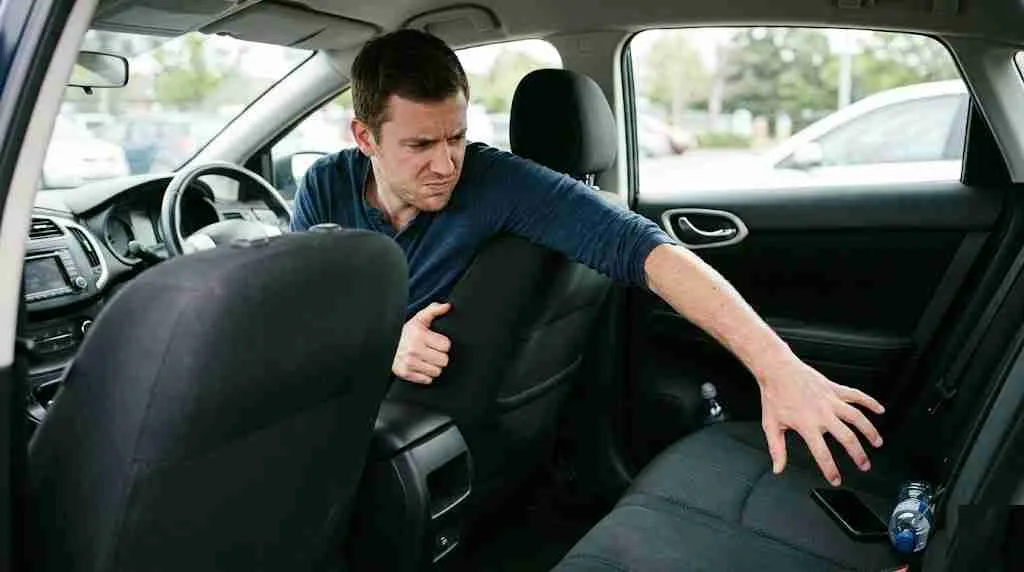 Reaching for something in the back seat: a higher-risk activity than the bench press.
The two failure modes pull in opposite directions. Do too little and you drift toward stiffness; do too much and you invite overuse. The fix has to thread between them, and that is exactly what the Unaging Challenge is built around. The bulk of the week is walking, an hour or two on most days, about the lowest-injury thing you can do with a body. Sitting on top of that is a small, capped dose of the harder work that actually drives longevity: strength, aerobic, and HIIT, held to sixty or ninety minutes across the whole week. Enough load to keep every joint strong and mobile, not so much that any tissue gets overrun.

The point is to keep this up for forty years, not to peak for one summer and limp through the next decade.
Overdid It? Ease Off, but Guard the Habit
When the ache comes from overdoing it, the cure is subtraction: drop the effort and give the tissue time to catch up. Lighter weight, slower pace, shorter distance. Most overuse aches settle within a few weeks once the load falls back to what the joint can handle.
This is the most important part, and the one people skip.
The habit is the asset. Years of showing up, of exercise being a non-negotiable part of your week, is worth more than any single workout. An injury threatens that habit far more than it threatens your body, because the natural move is to stop entirely and “rest until it’s better.” Then better never quite arrives, and the slot you used to fill with exercise fills with something else.
Don’t give up the slot. Reduce the load instead. Sore knee? Walk slower, or shorter, or switch to the parts of the routine that don’t aggravate it. Bad shoulder? Drop to quarter weight, or work the other side and the lower body. The exercise can shrink to almost nothing as long as the appointment with yourself stays on the calendar.
Keep showing up, even at 10% intensity, and two things happen. The joint heals, often faster, because gentle movement beats total rest for most musculoskeletal problems. And when it does heal, the habit is still there, intact, waiting to scale back up. Quit the slot, and you’re not recovering from an injury anymore. You’re starting over from zero, which is the hardest place to start.
Give the reduced load a few weeks to work. Most overuse injuries quietly resolve. The ones that don’t have changed category: pain that outlasts the rest period usually means the joint has lost some function along the way, and that calls for a different fix.
The Pain Is Rarely the Damage on the Scan
So the pain has outlasted the rest period, or it never came from activity at all: the back that stiffened from years at a desk, the shoulder that froze from disuse. You get it imaged, and the report comes back with frightening words: rotator cuff tear, herniated disc, bone spur, degeneration. It feels like a verdict.
Here is the thing almost nobody tells you. Those findings show up in enormous numbers of people who have no pain at all.
When researchers MRI the spines of people walking down the street with no back pain, disc degeneration appears in 37% of pain-free 20-year-olds and 96% of pain-free 80-year-olds.1 Disc bulges: 30% of symptom-free 20-year-olds, rising to 84% by 80. These are people with nothing wrong, who feel fine. The “abnormal” finding is closer to a gray hair than a broken bone, a normal mark of getting older.
Shoulders tell the same story. A village mass-screening with ultrasound found full-thickness rotator cuff tears in a quarter of the population, and roughly two-thirds of those tears caused no symptoms whatsoever.2 Over age 60, most people walking around with a torn rotator cuff don’t know it and don’t care, because it doesn’t hurt.
So if the bone spur and the bulging disc aren’t reliably the cause, what is? Usually something far more fixable: impaired joint function. The joint has stopped moving the way it should, the muscles around it have gone weak or stiff, and that, not the structural finding, is what hurts. This is the core insight of Jim Johnson, a physical therapist who has spent his career turning the research literature into plain self-treatment books, with the same approach for the knee, the back, the shoulder, the elbow, and more.3 His message: stop chasing the scary picture, and start restoring how the joint works.
 Studies show sloths never recover from back pain due to insufficient movement.
Fix the Function, Not the Picture
For most of the twentieth century, the prescription for a bad back was bed rest, sometimes a week or two flat on a mattress. Then the trials landed. A 1995 study in the New England Journal of Medicine split people with acute back pain into three groups: bed rest, back-mobilizing exercises, or simply carrying on with ordinary activity as the pain allowed. The resters recovered slowest; the ones who stayed active recovered fastest.4 Rest was making the back worse.
The modern understanding runs the other way, and it is almost dull: a cranky joint usually needs to move better and get stronger, not stop. The cure is unglamorous, simple, specific exercise and a few targeted stretches. Restore the range, rebuild the strength, and a surprising amount of pain quietly leaves.
And most of this was never about your workouts in the first place. The aches come from ordinary life asking too little of the body: eight hours in a chair, elevators instead of stairs, years without a deep squat or a heavy carry. The cause is mundane, and so is the cure. In the largest review of the question, 249 trials in all, exercise therapy beat doing nothing for chronic low back pain, the most common joint complaint there is.5 The body wants to be loaded and moved. Give it that, gently and often, and the joint tends to settle.

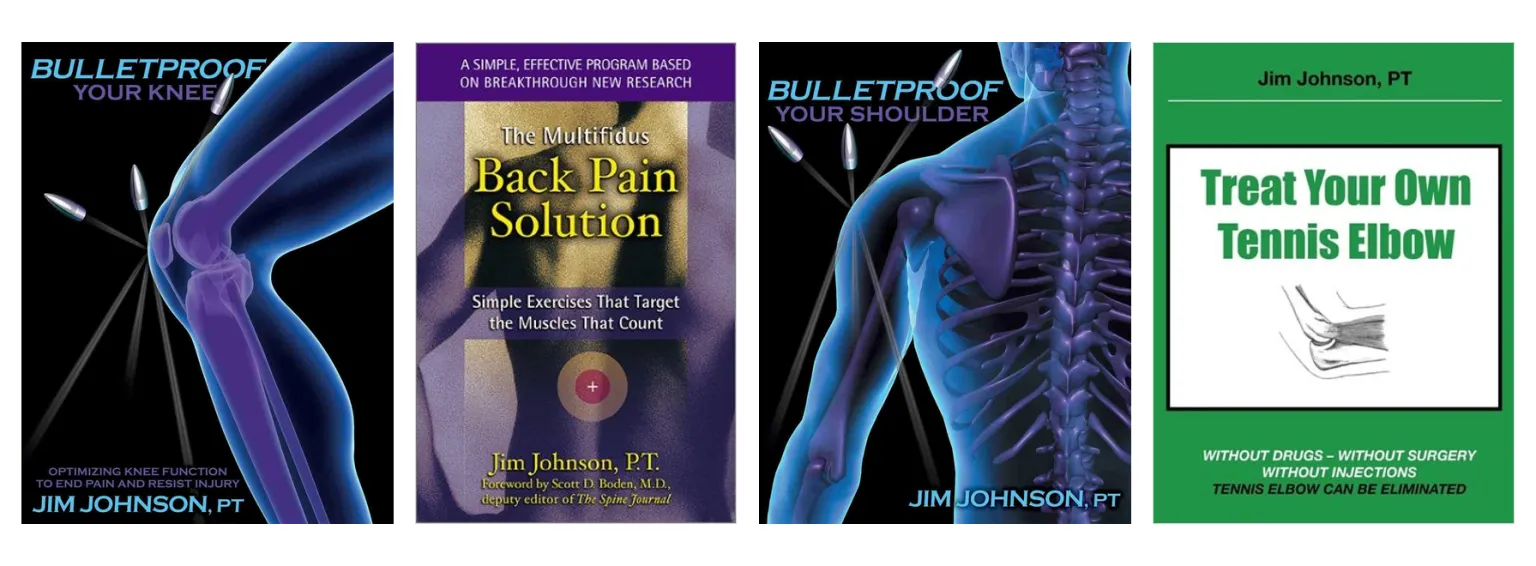 Knee, back, shoulder, elbow: whichever one hurts, there is a slim Jim Johnson paperback for it, and they all give the same calm advice.
This is Johnson’s whole method. His books are built on published controlled trials, and the prescriptions are deliberately minimal: not a sprawling rehab circuit, but a handful of precise exercises and stretches aimed at the joint that hurts. One book per joint:
- Bulletproof Your Knee
- The Multifidus Back Pain Solution (lower back)
- Bulletproof Your Shoulder
- Treat Your Own Tennis Elbow
(Not affiliate links — we just like the books.)
Restore range first, then rebuild strength in small, sustainable doses. A single set, every other day, in the 8-to-12-rep range is the shape of it. Fifteen minutes, not an hour. The minimalism is the point, because a program you’ll actually do beats a perfect one you abandon by Thursday.
Give a routine about six weeks. That is Johnson’s rule: if you have put in honest, consistent effort and the pain hasn’t budged in six weeks, don’t keep grinding the same drill, switch to a different approach. Most joints respond before then. And if nothing helps after a few honest attempts, that is your signal to see a doctor for a proper workup, the small minority of cases that truly need one. The six-week rule keeps you from two opposite mistakes: rushing to surgery for something that would have settled on its own, and stubbornly repeating a routine that clearly isn’t working.
The Short Version
Build a routine sane enough that sore joints are rare: mostly walking, with a small, capped dose of the harder work. If you overdo it, ease off and let the tissue catch up, but guard the habit: keep the slot on your calendar even at a trivial weight or pace. And when a pain outlasts the rest period, or grew out of years of not moving, look past the scan and rebuild how the joint works, with simple, specific exercise, six weeks per approach, and a doctor if nothing helps.
Get hurt less. Guard the habit. Fix the function. That’s how you stay moving for the next forty years.