
Last updated: August 31, 2026

 July 14, 2025
In This Article
What is High-intensity Interval Training?
High-intensity Interval Training (HIIT or HIT) is training at the upper end of the range where your body can provide energy from the oxygen you breathe. This effort is hard to sustain, so HIIT adds low-intensity or rest periods between the high-intensity periods. The high-intensity periods should be hard enough to leave you breathless — difficult to say more than a few words — but the pace should be one you can sustain for a minute or more. In general, the target heartbeat range is 85-100% of the maximum heart rate, although, for shorter intervals, it’s challenging to reach that rate during the initial repetitions.
Some famous examples of HIIT workouts are:
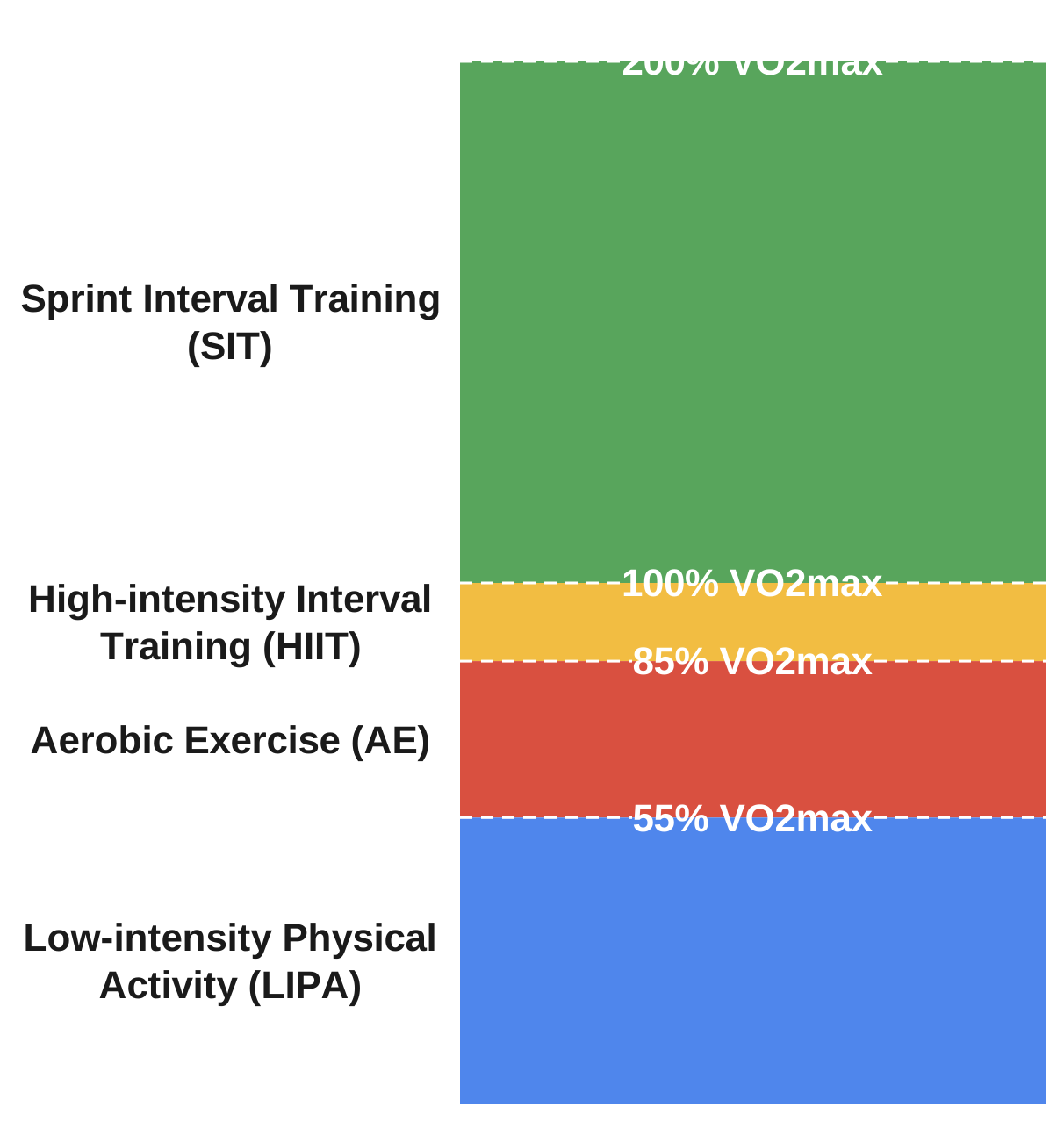 Interval training intensity chart: Sprint, High-intensity, Aerobic, and Low-intensity levels.
- The Tabata Protocol: Published by Izumi Tabata in 1996, this protocol popularized HIIT training in the eight repetitions of 20 seconds of maximal effort interspersed with 10 seconds of rest.
- The 4×4 Workout: This workout is recommended by the Norwegian University of Science and Technology. It starts with a 10-minute warm-up of moderate jogging, followed by four repetitions of 1-2 minutes of high-intensity running and then 3 minutes of jogging.1
Different exercises can be used for HIIT, including running, cycling, jumping jacks, or burpees. Generally, any activity that allows for intense effort can be used for HIIT.
Four Ways HIIT Improves Fitness
To allow increased performance at near the maximum sustainable rate, HIIT improves each step of how the body converts oxygen to energy:
1. Improved Lung Capacity
The first step to increasing oxygen use is to increase lung capacity, and indeed, HIIT can improve maximum inspiratory pressure, or the ability of the lungs to pull in air, by over 40%.2

2. Improved Heart Capacity
To get more energy from the oxygen you breathe, HIIT increases the maximal cardiac capacity, which is the ability of your heart to pump blood.3
3. Increased Capillary Density
HIIT also increases the capillary density to get more oxygen to the muscles that use it. The capillaries are the delicate blood vessels that deliver oxygen to your cells as the blood transfers from arteries from the heart to veins, going back to the heart.3
4. Increased Mitochondria

Six Benefits of HIIT
Some benefits of HIIT follow from its fitness effects listed above, but some come from other aspects of HIIT:
1. Improved Cardio-respiratory Fitness
 Having the energy to do the activities you want is vital to health, and HIIT can significantly boost cardio-respiratory fitness, a critical factor in how much energy you have. Cardio-respiratory fitness is often measured by your VO₂max, which indicates the maximum amount of oxygen you can process for energy. Training in HIIT for six weeks can increase VO₂max (a measure of cardio-respiratory fitness, which gives the maximum rate at which your body can use oxygen during exercise) by 10%.5
2. Fat loss
By raising your resting metabolic rate more than resistance exercise or AE, HIIT helps metabolize fat.6 Some studies have shown fat reductions from HIIT without changing dietary habits.7
3. Time Efficient
Aerobic Exercise (AE) also improves cardio-respiratory fitness. Still, the gains from HIIT are available with less total time exercising, especially if you only count the high-intensity effort time and not the lower-intensity rest periods. In general, a HIIT workout, including the rest intervals, takes about half as long as AE that would provide a similar cardio-respiratory boost.8
4. Lower Blood Pressure
Similar to AE, HIIT can lower blood pressure by up to 10 points after eight weeks of practice,8 which is as much as the effect of common blood pressure treatment medications.9
5. Reduced Insulin Resistance
The primary cause of Type 2 Diabetes is insulin resistance, and HIIT has been shown to have a significant impact in reducing insulin resistance.10
Signs of insulin resistance are fasting glucose level or hemoglobin A1C (HbA1C),11 which are standard blood tests. HIIT was found to reduce blood sugar by nearly one mmol/l and HbA1C by about .2%.
6. Longer life
Even for people already doing AE, the health benefits from adding HIIT to your weekly exercise routine can add years to your life. A 2020 Norwegian study showed that adding just two sessions of 4×4 HIIT reduced all-cause mortality by almost 50% compared with people only doing AE.12 Even starting from 50 years old, that could add seven years of life.
What are the best exercises for HIIT?
The best exercise is the one you can do at high intensity and you like. Brisk walking is probably not difficult enough to reach high intensity, but good options are running, cycling, or swimming. Fitness exercises like jumping rope, body squats, or burpees can also be good choices.
How much HIIT should I do?
A good target is about two 4×4 workouts per week. This is enough to provide the longevity benefits above, and when done consistently, will provide a steady improvement in cardio-respiratory fitness.
With this base of 2 HIIT workouts per week, the cardiorespiratory benefits of HIIT improve linearly by the product of the total amount of time exercised by the percentage of your maximum effort in watts.4 While the percent of your watt max is a little lower than the percentage of your heart rate maximum (HRmax), it’s a good guideline for how many weeks of HIIT are required to reach a particular V̇O2 max improvement. Fourteen months of two 4×4 workouts/week could be enough to increase V̇O2 max by about 10%. If you doubled the repetitions from 4 to 8 (an 8×4 workout), the same gain of 10% could be achieved in 7 months.

Frequently Asked Questions
1. How much does skipping some HIIT reduce fitness?
Detraining or stopping HIIT for two weeks or more has a significant impact on cardiorespiratory fitness. A two-week break could reduce V̇O2 max by 4%,13 which would take over 5 hours of high-intensity effort (not including rest intervals) to recover or half a year of two 4×4 sessions per week. Keeping up training at one session per week seems enough to maintain cardiorespiratory benefits. However, endurance may drop.14
2. Does playing sports count as HIIT?
Mostly, yes. While some sports, like golf, don’t have enough intensity, sports that often require speed dashes, like racquet sports, soccer, or basketball, give similar benefits to HIIT. Studies on sports participants find that these kinds of sports have the highest reductions in all-cause mortality.15
3. How much HIIT is too much?
So HIIT seems great, right? But, you can get too much of a good thing. As with other physical activities, there is a U-shaped curve of the benefits, where benefits reverse at high levels due to overtraining. After 160 minutes of HIIT effort time a week, performance flatlines, glucose intolerance starts to increase, and mitochondrial energy production decreases. Direct analysis of mitochondria extracted from thigh muscle showed that while the total amount of mitochondria was continuing to grow during the overtraining, but the amount of energy production per mitochondria dropped by 40%.16
4. How does HIIT differ from traditional aerobic exercise?
HIIT differs from traditional aerobic exercise in that it focuses on short, intense bursts of activity followed by rest, whereas traditional aerobic exercise involves sustained, moderate-intensity activity. HIIT can deliver similar or even superior fitness benefits in less time.
5. What are the benefits of HIIT for cardiorespiratory fitness?
HIIT significantly improves cardiorespiratory fitness 17 by increasing lung capacity, enhancing maximal cardiac capacity (heart’s pumping ability), and increasing capillary density to deliver more oxygen to muscles. These improvements result in better overall fitness and energy levels.
6. Can HIIT help with weight loss?
Yes, HIIT can aid in weight loss 18 by raising the resting metabolic rate, leading to increased fat metabolism. It burns calories not only during exercise but also after, thanks to the afterburn effect. It can be an effective tool for weight management.
7. Is HIIT suitable for people with high blood pressure?
HIIT has been shown to lower blood pressure over time. However, individuals with hypertension should consult their healthcare provider before starting any new exercise program, including HIIT, to ensure it’s safe and suitable for their condition.
8. How does HIIT affect insulin resistance and Type 2 Diabetes?
HIIT has a significant impact on reducing insulin resistance 10, a primary cause of Type 2 Diabetes. It can help lower fasting glucose levels and HbA1C, making it a valuable addition to diabetes management plans.
9. What exercises are best suited for HIIT?
The best exercises for HIIT are those that you can perform at high intensity and enjoy. Running, cycling, swimming, and fitness exercises like jumping rope, body squats, or burpees are excellent choices.
10. Is HIIT suitable for beginners, and how can they get started safely?
HIIT can be adapted for beginners. It’s essential to start gradually, with shorter intervals and lower intensity. Consult a fitness professional or trainer to create a safe and customized HIIT plan that aligns with your fitness level and goals. Always prioritize safety and proper form during HIIT workouts.
How much does your HIIT add? Take the biological age test to find out.









1 comment
This post is pretty cool. I love the actionable steps.