Last updated: July 22, 2026

 February 26, 2024
In This Article
When pursuing health and longevity, the number of possible interventions is staggering. From foods with varying health impacts to diverse physical activities, each promising unique benefits, there are far more options than meals or hours in the day. With the many options, a crucial question arises: How do we evaluate which interventions have enough impact to be worth our time and effort?
Further complicating choosing a health routine, interventions often come with a mix of benefits and harms. For instance, fruits provide healthy polyphenols and fiber but carry pesticides, which can cause cancer. Strength Training increases muscle mass and capability, but excessive Strength Training stresses the body, increasing cardiovascular disease risk.1 The many effects of food, exercise, and habits on the body make evaluating the net health effect of interventions challenging.
Hazard Ratios
Enter Hazard Ratios (HR). HR typically refers to the ratio of death from all causes over a given period compared to a control or reference case. However, it can also refer to a particular event, like a stroke or death from cardiovascular disease. An HR of 1.0 or 100% means that the intervention did not affect survival compared to the control. An HR of less than one implies the intervention reduces premature death, and an HR over one means the intervention is associated with earlier death than expected.
Why Hazard Ratio is a Superior Metric
1. Mechanism Agnostic
Many descriptions of interventions will tell you that doing X will benefit biochemical process Y. Therefore, you should do X. Biology is exceptionally complex. It’s challenging to see if biochemical process Y is genuinely beneficial in the amount given from X, when X increases it, how many people need more Y, if Y still increases after months, etc. All of these questions can be resolved by looking straight at the HR effect on premature death. No matter how wonderful Y sounds, the conclusive measure is the lifespan impact. And, yes, a longer lifespan is well correlated with a longer span of healthy life.2

2. One Metric to Rule Them All
As mentioned above, many interventions can mix both positive and negative effects, like fruits and vegetables reducing cardiovascular risk, but also possibly carrying pesticides, which can increase cancer risk. Using HR enables direct comparison of these effects by looking at the overall survival rate.
3. Determining the Right Dosage
Not only does HR help in judging the effectiveness of an intervention, but it also aids in determining the appropriate dosage. For instance, while exercise is generally beneficial, extreme levels can stress the body, and HR can show how the benefit or harm changes over different dosages. For fruits, HR reduction in premature death is significant up to the second serving, and there is a little more for the third serving, but there is no significant improvement after that.
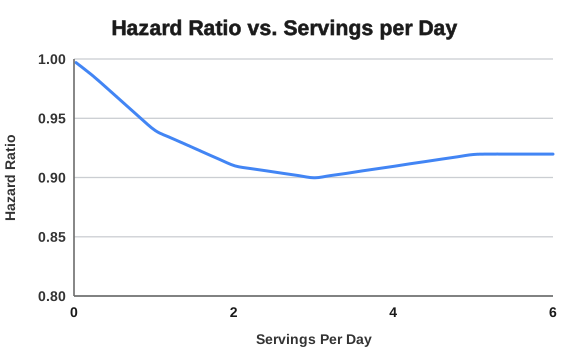 Twice daily does the job
4. Comparison Between Health Interventions
Which increases longevity more: drinking 2.5 cups of drip coffee weekly or spending a weekly hour on Strength Training? Strength Training reduces HR by 35% compared with 27% for Drip Coffee.
Which is more harmful, eating one ounce (28g) sausage daily for breakfast or having a daily can of coke? The sausage increases 12% of HR vs. 10% for the coke.
Once familiar with HR impacts, the effect of HR reduction can used to compare different interventions and judge whether they’re worth adding to your routine. When I see a study that such-and-such supplement reduces HR by 9%, I compare that with the HR of other interventions. Eating one serving of fruits or vegetables is about the same HR reduction (9%), drinking 2.5 or more cups of drip coffee drops HR by 27%, and walking 12,000 steps daily reduces HR by 60%. I’ll stick with drinking coffee and walking and pass on the supplement.
Further Lessons from Hazard Ratios
In cases where different interventions are combined, HR can help understand whether these interventions have a cumulative effect, counteract each other, or have a neutral interaction. This analysis is vital in designing effective health strategies. For example, eating various fruits would give more advantages than just one or two kinds. As people eat more servings of fruit, as you would expect, they eat a greater variety of fruit.3 Look again at the fruit HR chart above. Since people who eat more servings of fruit have more variety, if the variety further reduces the HR, the HR should continue to decrease with additional servings. Still, instead, the trend is flat after three servings. The benefit of fruit is fruit, and it is not particular to eating a variety. The same pattern appears for vegetables, as well.
Hypothesis Testing with Hazard Ratios
Comparison of HRs can be used to evaluate possible drivers of different interventions. For example, walking reduces the HR of death by nearly 60% when walking over 12,000 steps daily. Walking that many steps is over an hour daily, so you might wonder, “Can I take those steps fast by running for the same benefits?”
Let’s compare them. Here are the HRs of running vs. walking, indexed by the number of steps weekly:
 One of these things is not like the other…
While they both provide a reduction in the HR, it’s clear that the benefit is less for running after 50,000 steps weekly, where the running HR benefit begins to decrease. Indeed, studies have quantified that the benefit from walking is different and in addition to the HR benefits of aerobic exercise.4
Common Factors and Hazard Ratios
As another example, two foods give outsized reductions in HR at low doses — nuts and olive oil. At first glance, they are pretty different. Nuts contain fiber, protein, various vitamins (folate, etc.), and minerals (magnesium, zinc, and potassium). Olive oil has polyphenols and is primarily made of mono-unsaturated fats.
Look at the HR graphs for mixed nuts and olive oil, indexed by one nutrient they share — mono-unsaturated fat content. Given the similarity in the HR graph, I suspect that mono-unsaturated is the primary driver of their benefits.
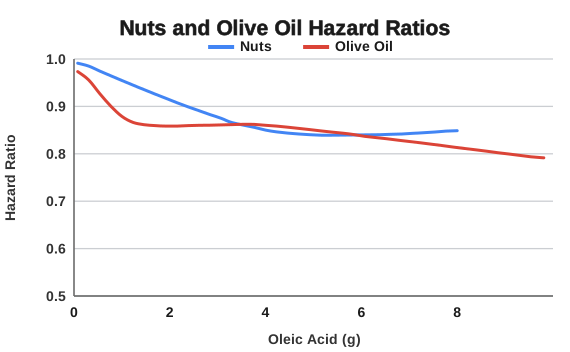
As noted before, it’s essential to get this small dose of either nuts or olive oil daily; bingeing at the end of the week gives less benefit. Daily intake probably accounts for the apparent smaller benefit of olive oil over nuts at the small dose of one gram daily. It’s reasonable to have a couple of grams of olive oil with salad or bread daily, but less than ten grams of nuts may be less common than eating twenty grams every other day.
Conclusion
Hazard Ratios are a beacon of clarity in a world brimming with health advice and interventions. It simplifies the complex decision-making process in personal health by providing a comprehensive, overarching metric that captures the net effect of various health interventions on our overall life expectancy. Look for the impact on HR when evaluating health interventions to make informed decisions for a healthier, longer life.