Last updated: September 23, 2026

 January 31, 2025
In This Article
The UK study’s finding was puzzling: people who exercised at midday showed 10% lower mortality than those working out in the morning or evening.1 I didn’t expect the timing of exercise to have such a significant impact. Looking for an explanation led me to examine another variable entirely: sunlight exposure.
Beyond Vitamin D
The MISS (Melanoma in Southern Sweden) study provided the first key insight: women with the highest sun exposure showed 38% lower all-cause mortality than sun avoiders.2 This reduction came from 50% less cardiovascular disease (CVD) and 40% less non-cancer, non-CVD deaths, while cancer mortality remained unchanged.3 This matched the findings from the UK study – afternoon exercisers had less CVD and non-CVD, non-cancer mortality, but cancer mortality was unchanged.
The discovery in 1924 that ultraviolet light could cure rickets4 revealed one of the first direct benefits of sunlight. Unfortunately, similar to finding that plant foods contained fiber, this discovery led to the oversimplified assumption that all benefits from sunlight came from vitamin D. People with high blood levels of vitamin D do better on many health metrics, like blood pressure5 or cardiovascular disease (CVD).6 This led researchers to think vitamin D caused these benefits rather than recognizing it as a marker for getting different benefits from sunlight. The proof came later, as repeated studies showed that vitamin D supplementation did not provide nearly the benefits of sunlight.7 Blood vitamin D serves more as a measure of recent sun exposure than the source of sunlight’s benefits.
Moving Up the Spectrum
The “Sunlight, Time for a Rethink?” review in the 2024 Journal of Investigative Dermatology8 examined sunlight’s benefits beyond vitamin D. It found that living 300km further south in the UK corresponded to 6% lower mortality.9 Death rates showed clear seasonal patterns based on sun exposure. Different skin types responded distinctly – Black individuals showed 28% less seasonal blood pressure variation,10 while redheads, whose skin is most sensitive to sunlight, demonstrated lower mortality in low-light environments but not near the equator.11
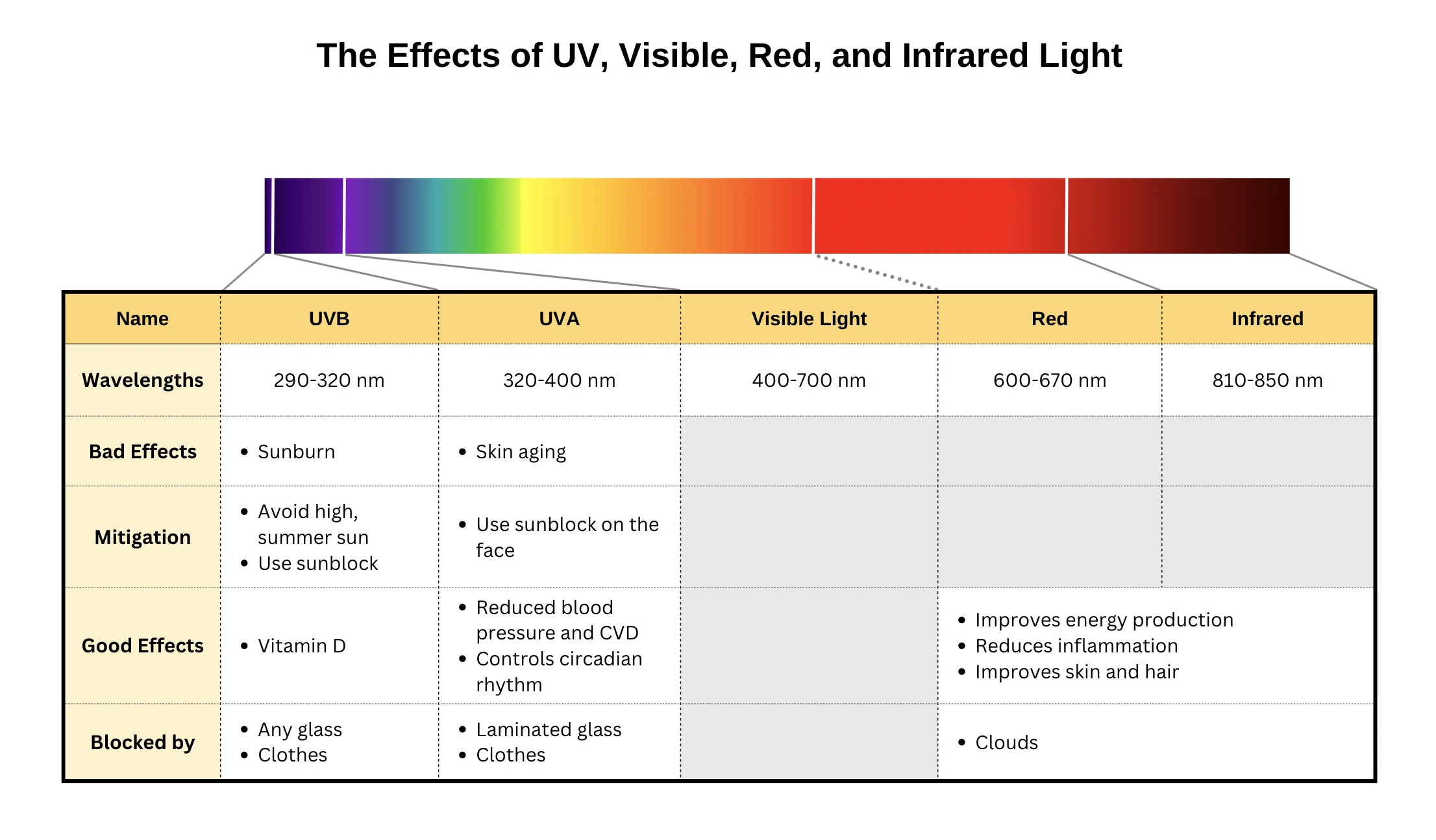
The review concluded by adding UVA effects to the benefits of sunlight. UVA reduces blood pressure through nitric oxide release. This effect persists for days after exposure (termed the “Dark Reaction” due to our limited understanding of its mechanism).12 While this explains the cardiovascular benefits, studies showing UVA’s impact on other causes of mortality are sparse. The benefits beyond CVD seen in the Swedish research suggest additional mechanisms beyond UVA’s cardiovascular effects.

The Red Light Connection
At the opposite end of the spectrum from UVB and UVA lies red light, at the edge of the visible spectrum, and beyond it, infrared light. Together, these wavelengths comprise over 40% of sunlight’s energy.
The key difference between red and infrared light is penetration depth. Red light’s shorter wavelength and higher energy mean more is absorbed by the skin, while infrared light can penetrate deeper into the body. Thus, surface skin or hair treatments focus on red light, while muscle and inflammation treatments use infrared light. Despite the difference in wavelengths, both appear to work through similar mechanisms—either light will provide benefit, but using both kinds doesn’t improve on using one alone.
These wavelengths improve health through two primary mechanisms:
1. Mitochondrial Enhancement
Mitochondria are the energy stations of the cells, and red light and infrared can up to double mitochondrial energy production,13 leading to dramatic improvements across multiple systems:
- Skin rejuvenation: 38% reduction in wrinkle depth and 23% increase in skin firmness14
- Hair density increase of 15% after a 24-week treatment15
- Strength gains – a twin case study demonstrated 90% greater strength improvement and a 4-fold increase in muscle growth with infrared therapy16
2. Inflammation Reduction
The anti-inflammatory effects provide therapeutic benefits for multiple conditions:
- Reduces arthritis symptoms and joint pain17
- Decreases COVID-related inflammation by 50%18
- Accelerates wound healing19
The Skin Cancer Question
Despite the benefits of sunlight, the relationship with skin cancer is nuanced. Sun exposure, especially during times with a high UV Index, increases the chance of melanoma or skin cancer. However, the Swedish MISS study and a study from Australia20 found that despite this increased melanoma incidence, the chance of mortality from skin cancer overall drops with increased sun exposure. The Australian study showed that skin damage from sunlight corresponded to 60% lower skin cancer mortality rates. Regular exposure appears to activate protective mechanisms that improve survival outcomes.

Practical Applications
The light-avoiding group in the MISS study weren’t extreme sun avoiders – most people today get less sun exposure in an entire year than a single tanning session. Simple changes can significantly increase beneficial light exposure:
Natural Sunlight

Exercise or spend time outdoors during midday hours under clear skies, when beneficial wavelengths are most potent. Use sunscreen on the face to prevent burning and photoaging while allowing body exposure.
Targeted Light Therapy
For those seeking additional benefits, specialized hardware options exist:
- LED-equipped caps for hair regrowth
- Facial masks with specific wavelengths for skin rejuvenation
- Full-body red light panels for systemic benefits
Important Considerations
Red light therapy shows biphasic responses21, meaning there’s an optimal exposure window beyond which benefits diminish. The initial inflammatory response to red light exposure triggers longer-term anti-inflammatory adaptations, similar to how exercise creates temporary stress that leads to improved fitness. When using targeted devices:
- Follow recommended exposure times
- Start with shorter sessions
- Monitor your response
- Maintain consistency rather than attempting to compensate for missed sessions with more prolonged exposure.
Synthesis
Understanding sunlight’s health effects requires considering multiple wavelengths and mechanisms. UVA improves cardiovascular health through nitric oxide pathways. Red and infrared light affect cellular function and inflammation through distinct channels. Each wavelength contributes specific benefits that vitamin D supplementation alone cannot replicate.
Individual factors influence optimal exposure patterns, including skin type and health conditions. Clear skies maximize benefits, as clouds significantly block beneficial wavelengths. While clothing permits some light transmission, direct exposure provides the complete spectrum of beneficial wavelengths.
The evidence is compelling – regular sun exposure reduces premature death by 38%, making it one of the most powerful interventions available for longevity. The key is finding your personal sweet spot – enough exposure to activate these beneficial pathways while avoiding overexposure. For most people, this means simply spending more time outdoors during daylight hours, particularly around midday when beneficial wavelengths are strongest.
What are your habits worth? Take the calculate your biological age in two minutes.