
 October 28, 2026
In This Article
Testosterone Replacement Therapy (TRT) is increasing in popularity, jumping from about 0.64% of male patients in 2021 to 0.93% in 2025—an increase of about 45%.1 Let’s take a look at the positives and negatives of TRT, and how it affects longevity.
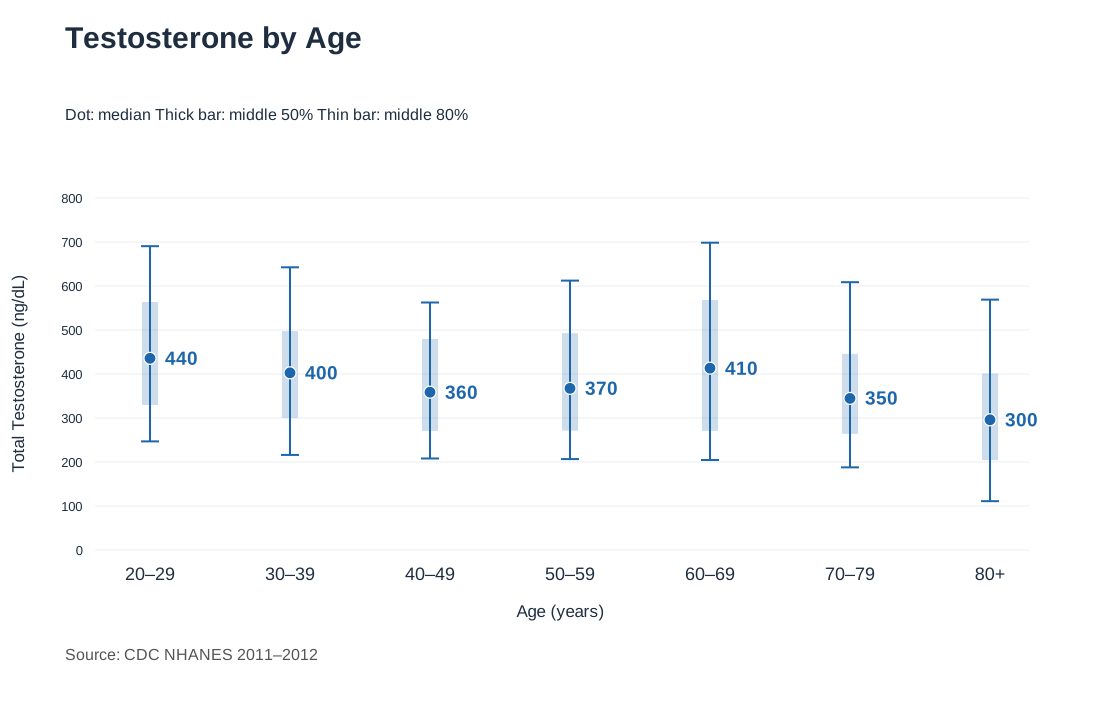
According to the American Urological Association, consideration for TRT starts when Total Testosterone (TT) is below 300 ng/dL.2 In the Massachusetts Male Aging Study, TT dropped about 1.6% per year in men aged 40–70 at enrollment.3 There are some studies that show that TT is dropping over the decades even for men of the same age, but it’s difficult to get comparable historical measurements.45
TRT Benefits
Body Composition: Although not increasing overall weight much, people on TRT notice a shift from fat to lean mass. In one randomized controlled trial without a particular weight loss goal, TRT reduced fat mass by about 2 kg and increased lean mass by about the same amount.6 That said, the difference didn’t transfer over to functional strength.6
Libido and Sexual Activity: Both sexual desire and activity were found to increase with TRT, although the effect size was small (0.2-0.3 SMD). TRT is not an effective replacement for Viagra-type drugs, as erectile dysfunction was not found to improve.7
Mood: Similar to other results, the Testosterone Trials found that TRT reduced depressive symptoms by a small amount, with an effect size of 0.18 SMD.8
TRT Cautions
Note that all of these effects are at best small, and that’s in the particular group that should benefit the most, such as reducing depressive symptoms for depressives. For people not qualifying for TRT or without issues with the above there’s unlikely to be significant benefit. The goal of TRT is to bring TT up to the range of 450-600 ng/dL.2 For people starting near that range, there’s unlikely to be a noticeable difference.
The other caveat for taking testosterone is that the body regulates overall T closely. If you have 400 ng/dL TT levels, and you tried adding 100 ng/dL, your body may respond by turning off your native production of T, resulting in less total testosterone. Once started down the path of increasing testosterone, the normal approach is to supplement enough to replace all natural production of testosterone, which often goes to near zero.9
The body’s natural testosterone production happens in the testes and is strongly connected with sperm production. As a result, with testosterone supplementation, sperm production practically vanishes, dropping by about 99% compared with placebo in one trial.10
Recovery from those hormonal changes after stopping TRT takes time. In healthy men, sperm counts typically recovered about three months after stopping testosterone.11 However, after two years of testosterone treatment, hormonal recovery can take more than a year.12

TRT Effects on Health and Longevity
But aside from mood or muscle benefits and natural T and sperm production impacts, is TRT good or bad for your overall health? The TRAVERSE study followed about 5,200 men for an average of 2.8 years, and found the all-cause mortality of the men on TRT was 5.5%, compared with the worse 5.7% for controls.13 That’s not statistically significant, so the study didn’t establish a longevity benefit. Likewise, earlier warnings about TRT and cardiovascular or prostate issues are being removed as more studies are conducted.
Raising Testosterone
Exercise Doesn’t Move Resting Testosterone
Despite a brief burst of T during and after a workout, a meta-analysis of 11 randomized trials found no effect on resting T from exercise, whether aerobic or strength training.14 This burst of T after a workout wasn’t associated with gains in muscle or strength.15
Doubtful Supplements
Herbal testosterone boosters are heavily advertised, but the evidence is thin: most positive trials are vendor-funded, and independent trials rarely show significant changes.
| Name | What it is | Evidence |
|---|---|---|
| Ashwagandha | Shrub root extract. | Small pooled T effect; results become non-significant when limited to trials without vendor funding.16 |
| Tongkat Ali | Tree root extract. | Pooled T effect shows no significant impact.17 |
| Fenugreek | Herb seed extract. | Small T gains; a 2017 study was written by the sponsor’s president and chief scientist.18 |
| Tesnor | Pomegranate and cocoa extracts. | Positive T trials funded by its manufacturer.19 |
| Shilajit | Mineral-rich material from rock. | Positive T trials; the 2026 preprint includes manufacturer staff and a co-founder as authors.20 |
| Cistanche | Desert plant extract. | 2025 university trial (48 men, eight weeks): T ended about 110–140 ng/dL above placebo. Unreplicated.21 |

Conditional Benefits
Zinc deficiency: Zinc is required for enzymes and normal testicular function to make testosterone, so a zinc deficiency can lower testosterone. This is most apparent in people with kidney failure, which reduces their zinc retention.22 About 29% of zinc in the American diet comes from red meat, with another 13% from dairy, so vegans or people following the Unaging diet may be getting less zinc.23 A small study of zinc-deficient older men found that testosterone nearly doubled after six months of zinc supplementation.24
Obesity: Losing a few pounds for an overweight person may not make much of a difference, but for people with a BMI over 30, losing weight can raise testosterone. A 2003 Finnish study looked at 38 middle-aged men with a BMI over 35, and tracked their testosterone as the treatment group lost about 14% of their body weight. Testosterone significantly increased by about 80 ng/dL more than in controls.25
The Bottom Line
For men with low testosterone, TRT has some benefits. For most men, TRT won’t make much of a difference, while shutting down natural T production and sharply reducing fertility until months after they stop treatment. For men without low T there aren’t many ways to shift it higher. Supplements have doubtful effects and exercise only provides a short-lived increase. Those deficient in zinc may benefit from a zinc supplement. Losing weight, especially for the obese, is another way to raise T levels.